
Open a contractor website, turn the images off, and read what is left. That is close to what a machine gets. On most construction sites what remains is a company name, a menu, a phone number and three paragraphs of general language about quality and communication. An engine asked to name a commercial concrete contractor in a specific county has nothing in that to work with, so it names a company that gave it something.
What does an AI engine see when it reads a contractor website?
An AI engine sees text and structured data. Headings, body copy, link text, alt attributes and schema markup are readable. Photographs, background video, slider animations and text baked into images are not. A contractor site carrying its proof in pictures is invisible on the surfaces that answer questions.
This is why portfolio pages underperform so badly. A jobsite album is real evidence of capability and it carries no meaning without written scope beside it. The same applies to capability statements published as downloadable PDFs that never appear as page content.
What is an entity block and why does a contractor need one?
An entity block is the plain statement of what a company is, where it is based and what it does, repeated in identical wording across every page. It appears in visible prose in the first 150 words and again in structured data. Engines use it to decide which company a page describes.
Schema.org, the shared vocabulary search engines read structured data from, publishes a LocalBusiness type with a HomeAndConstructionBusiness subtype built for this purpose, alongside Organization and Service types. Google is blunt about the limits here, stating in its guidance on AI features that no special schema.org markup is needed to appear in AI Overviews or AI Mode. What markup does is remove ambiguity about the category, and it has to match the visible text on the page.
The markup has to agree with the visible page. Name, address and phone in the schema, the footer, the contact page and every directory listing should match character for character. A suite number in one place and not another is enough to split one company into two records, and a split record gets cited less than either half would have.
Which facts are usually missing from contractor websites?
Most contractor sites carry two or three of the facts an engine needs. The commonly missing ones are the trades performed by name, the counties served, typical project size, license and registration numbers, whether the company self-performs or subs out, residential versus commercial mix, and bonding and insurance limits.
Read a homepage and count. Every absent fact is a question the engine answers by leaving the company out of the response. This is the single largest gap on contractor sites and it costs nothing to close, because the information already exists inside the business.
Naming people belongs on the same list. A construction background is a real differentiator and an unnamed one is unverifiable. Bios with names, roles and years in the trade give an engine something to attach the claim to. That is also where owned content stops being enough, since verifiable people are what third parties end up quoting.
Do registration numbers belong on a contractor website?
In several states a registration number is required in advertising, and a website is advertising. Pennsylvania contractors performing home improvement work must register under the Home Improvement Consumer Protection Act and display the registration number clearly in all advertisements, contracts, estimates and proposals.
The Pennsylvania Office of Attorney General states the requirement plainly in its HICPA guidance, updated 25 June 2026: the number must use the PA prefix, must appear in advertisements, contracts, estimates and proposals, and must be clearly and conspicuously displayed. The act applies to work on private residences, not commercial property, and registration must be renewed every two years.
Compliance is the first reason to publish the number. The second reason is that a registration number is a verifiable identifier, and verifiable identifiers are exactly what an engine can attach to a company with confidence. A contractor who publishes a checkable number is easier to name than one who does not.
What parts of a contractor website can a machine not use?
Machines cannot read photo galleries without captions, capability statements locked inside PDFs, contact details set as images, video without transcripts, or testimonial sliders built in scripts that load after the page. Each of those is a place where a contractor’s strongest proof stops at the browser.
Video is worth calling out because it is the easiest recovery. A construction company with a YouTube channel is already ahead of most of its trade. The transcript is the part a machine reads, so publishing it alongside the embed converts a video asset into text an engine can quote.
Testimonial sections deserve the same attention. An empty block with a heading promising client feedback is worse than no block at all. It reads as an abandoned page to a human and returns nothing to a machine.
How should a contractor write a page so an engine can quote it?
Write short, self-contained answers. A passage that works when it is lifted out of the page and read alone is the passage that gets used. Name the company, the trade and the region inside the answer, open with the answer rather than a preamble, and refer to nothing above or below on the page.
That rules out a common habit. “As mentioned above, our team handles this” is unusable, because the engine takes the passage and not the context around it. So is “we” without a nearby company name.
Project pages follow the same discipline. An entry with six photos and a company name is a dead end. The same entry with the scope, the square footage, the system installed, the schedule and the problem solved is a page an engine can quote and an owner can evaluate.
What order should this work be done in?
Access first, accuracy second, depth third. Confirm crawlers are allowed and pages are indexed. Correct the entity facts and the schema so every reference to the company agrees. Then write the answers. Reversing that order produces good writing on pages nothing can reach.
The full sequence for a contractor runs longer. Unblock crawlers, submit the sitemap to Bing as well as Google, resolve duplicate pages and redirect chains, claim and complete the business listing, add Organization and LocalBusiness schema, write the depth pages, publish video with transcripts, then pursue trade coverage. FAQ markup no longer earns a rich result in Google, which dropped that feature in May 2026, so add it only where it describes questions a visitor can see.
The technical steps are cheap and fast. Everything downstream depends on them, and a contractor who skips them is paying for content on pages that no engine can see.
Frequently Asked Questions About Contractor Websites and AI Engines
01Does a contractor website need schema markup?
Not for Google’s AI features, which Google says need no special markup. Schema still earns its place by stating the business category outright rather than leaving an engine to parse it from prose. Organization and LocalBusiness are the practical starting points, and any markup must match what a visitor can see.
02What schema type should a construction company use?
Use the most specific accurate type. Schema.org offers HomeAndConstructionBusiness under LocalBusiness, with narrower subtypes beneath it, plus Service markup for each service page. A marketing agency serving contractors would use ProfessionalService rather than a construction type, since the markup must describe the company itself.
03Does a Pennsylvania contractor have to put a registration number on the website?
Contractors performing home improvement work on private residences in Pennsylvania must include their registration number in advertisements, which covers a website. The number uses the PA prefix and must be clearly displayed. Commercial-only work falls outside the act. Confirm current requirements with counsel or the Attorney General’s office.
04Do photo galleries help a contractor appear in AI answers?
Not on their own. Images carry no readable meaning, so a gallery without captions returns nothing to an engine. Adding written scope, project size, system installed and location beside each set converts the gallery into quotable content while keeping its value for human visitors.
05Should a contractor publish video transcripts?
Yes. A transcript turns a video into text that search engines and AI systems can read, and Google’s guidance asks that important content be available in textual form. Publishing the transcript on the matching service page supports both the video result and the written page.
06What is an llms.txt file and does a contractor need one?
An llms.txt file is a plain text file at the site root describing site structure for AI agents. Google states you do not need AI text files to appear in its AI features, and no major engine has confirmed using one. The cost is near zero, so treat it as optional and unproven.
This article is general industry information and is not legal, tax, or trade compliance advice. Requirements change and vary by state. Confirm current rules with your counsel or the relevant agency.
MFG Builders: How We Handle the Facts a Machine Reads
MFG Builders is a marketing agency for construction companies, based in York, Pennsylvania. Our team worked in construction before working in marketing, and we have built websites and search strategies for contractors across the country.
Our Services Include:
- Construction Website Design: Pages built to carry the facts a machine reads, with trades named, counties named and project scope written beside the photos
- Construction Website Maintenance: Schema, NAP and registration details rechecked on a cycle, since an entity record splits the moment one listing stops matching
Want to know which facts your site is missing? Request a quote and we will look at what is actually there.
Works Cited
- Pennsylvania Office of Attorney General. “Frequently Asked Questions: Home Improvement Contractor Registration.” Pennsylvania Office of Attorney General, updated 25 June 2026, https://www.attorneygeneral.gov/businesses-and-organizations/home-improvement-contractor-registration/frequently-asked-questions/.
- Google. “AI Features and Your Website.” Google Search Central, https://developers.google.com/search/docs/appearance/ai-features. Accessed 31 Aug. 2026.
- Schema.org. “LocalBusiness.” Schema.org, version 30.0, 19 Mar. 2026, https://schema.org/LocalBusiness.
Keep reading
AI-Powered Search Engine
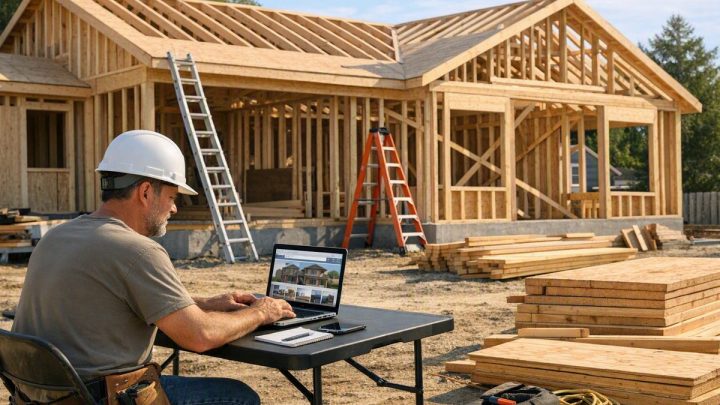
AI Search for Construction Websites: What Owners See Before They Call
Half of American adults now use an AI chatbot. Pew Research Center surveyed 5,119 U.S. adults from February 17 to 23, 2026…

Seo
SEO Versus AEO for Construction Companies
There are close to a million construction business locations in this country. The Bureau of Labor Statistics counted 953,703 private construction establishments…
Data Centers Are Splitting Construction Backlog in Two
The headline number looks fine. Backlog looks fine. Underneath it, the market has quietly separated into two economies, and most contractors are…