
The construction market is not having one year. It is having two. The U.S. Census Bureau reported on 1 October 2026 that construction spending ran at a seasonally adjusted annual rate of $2,203.1 billion in August, and that spending over the first eight months of 2026 came to $1,450.4 billion, down 3.1 percent against the same period in 2025. Inside that decline, private office construction ran 29.8 percent above August of last year while private manufacturing construction sat 19.8 percent below it and private residential was down 4.8 percent.
A contractor reading those numbers is reading about two different businesses. One is chasing work that is shrinking. The other is turning down work. Which one a company ends up in depends partly on what it builds and where, and partly on whether the owners awarding the growing work have ever heard of it.
What is digital marketing for a construction company?
Digital marketing for a construction company is the set of online channels that put the company in front of the people who award work: a website, search visibility, paid search, social profiles, and the listings and directories owners check. For a contractor it is a bid-pipeline function rather than a branding exercise.
The distinction matters because most marketing advice is written for companies that sell something a stranger can buy in one sitting. A contractor sells a six-figure project to a buyer who will check references, pull a certificate of insurance, and ask three other people about you first. The job of the marketing is to survive that checking, not to close the sale.
That reframes every channel. A website is not a brochure, it is the page an owner opens while a GC is talking about you. Search visibility is not traffic, it is whether you exist in the research that happens before the call. Social profiles are not engagement, they are proof the company is active and the crews are real.
Why does marketing matter more in a split market?
In a flat market, existing relationships carry most contractors through. In a split market, the trades on the shrinking side have to go find work in categories and regions they have not served before, and the owners in those categories have no relationship with them. Visibility is how a contractor crosses from one side to the other.
The labor data points the same direction. The Bureau of Labor Statistics reported on 2 October 2026 that construction employment rose by 11,000 in September, in line with a 12-month average of about 10,000 a month, with nonresidential specialty trade contractors continuing to trend up by roughly 12,000. Crews are moving toward the work. The companies moving with them are the ones who can be found in the new category.
A residential remodeler trying to pick up light commercial tenant fit-out is a different company to a property manager searching online than it is to a homeowner. Nothing about the crews changed. What has to change is the page the property manager lands on.
Which digital channels actually produce work for contractors?
Four do the heavy lifting: the company website, organic search, paid search during bidding season, and a claimed business listing. Social media and video support credibility rather than generating inquiries directly. Email matters for repeat clients and general contractors who already know the company.
The website. Everything else points here, and a weak one wastes the rest. Services named, service area named, project history with written scope, licensing visible, and a phone link that works on a phone.
Organic search. Slow, cumulative, and the only channel that keeps producing after you stop paying. It is also the one most contractors do backwards, optimizing for the trade and ignoring the geography. Where the permits are being pulled is the better starting point.
Paid search. Useful when timing is tight, a crew comes free, or a season is about to open. Expensive as a permanent substitute for the organic work.
The business listing. A claimed, complete profile with correct categories and service area. For any search with a place name in it, the listing is doing more work than the website.
Social media earns its keep differently. A project owner who has already found you will look at the feed to see whether the company is busy and whether the work looks like theirs. That is a credibility check, not a lead source, and treating it as a lead source is how contractors end up paying for posts that produce nothing.
Which trades are most exposed right now?
The August 2026 Census figures separate the categories sharply. Against August 2025, private office construction ran up 29.8 percent and private power up 9.7 percent, while private manufacturing was down 19.8 percent, lodging down 10.1 percent, private educational down 8.0 percent, and both commercial and private health care down 5.4 percent.
Public work tells a steadier story. Total public construction was 2.5 percent above last August, with highway and street up 4.4 percent and conservation and development up 28.4 percent. A contractor with the bonding and the prevailing wage experience to chase public work has been in a different year than one without.
Read as a marketing brief rather than an economics report, the table says something simple. A trade concentrated in manufacturing or hospitality work has spent the year watching its category shrink by double digits. The crews, the equipment and the competence transfer. The visibility does not, because the owners awarding office fit-out and power work have never searched for that company and would not find it if they did.
That is the specific job marketing does in a year like this one. Not brand building. Building the pages, the proof and the search presence that let a capable company be considered for a category it has not worked in before.
How do general contractors and owners actually find subcontractors?
Through a mix of existing bid lists, referrals from other trades, plan rooms and bid platforms, and search. The first three run on relationships a company already has. Search is how a contractor gets onto a list it is not already on, which is why it matters most to companies trying to change categories or regions.
The sequence is usually the same even when the source differs. A name surfaces, from a bid list or a recommendation or a search, and then the checking starts. Someone opens the website. Someone looks for comparable project history. Someone asks whether the company self-performs the scope or subs it out. Someone wants to see insurance limits and, on public or larger private work, bonding capacity.
A company that survives that checking gets a bid invitation. A company whose site is a slideshow with a phone number does not, regardless of how good the referral was. This is why the website matters even to contractors who insist they get everything by word of mouth. The word of mouth still routes through the website before the call happens.
It also explains why generic marketing advice lands badly in construction. The buyer is not being persuaded. The buyer is verifying. Copy written to persuade reads as evasive to someone trying to verify, and the pages that work are the ones that answer questions plainly and quickly.
What does a contractor website need to have?
It needs the facts an owner would otherwise have to ask for on the phone: trades performed, counties served, typical project size, whether the company self-performs or subcontracts, license and registration numbers, insurance and bonding, and completed projects with written scope rather than photos alone.
Most contractor sites carry two or three of those. The rest live in the estimator’s head. Every missing fact is a question the visitor answers by closing the tab, and increasingly it is a question a search engine answers by naming a different company.
Project pages are where the gap is widest. A gallery of six photos with a company name underneath proves almost nothing. The same entry with the scope, the square footage, the system installed, the schedule and the problem solved is something an owner can evaluate and a specifier can quote. What goes on those pages is a longer subject, and it carries two legal requirements most contractors have never been told about.
How much marketing should a construction company do in-house?
Photographs, project details and job stories should come from inside the company, because nobody outside it has them. Technical work, search strategy and ongoing publishing usually do not fit around a bid schedule. The common failure is an agency writing generic copy because the contractor never supplied the specifics.
A practical split: the field supplies raw material, someone else turns it into pages. A project manager sending four phone photos and three sentences about a tricky tie-in at the end of a job is worth more than a full day of agency brainstorming, and costs the company nothing.
Where that breaks down is when nobody owns the handoff. The photos sit on a phone, the site stays generic, and the contractor concludes marketing does not work for construction. The work was never the problem.
What does a contractor get wrong about marketing spend?
Two things. Treating it as a switch rather than a pipeline, turning spend on when work is thin and off the moment the schedule fills, and buying channels in isolation. Paid ads pointed at a website that cannot answer an owner’s questions spend money to deliver visitors who leave.
The switching problem is particular to construction because the schedule swings so hard. A contractor three months deep in backlog has no appetite for marketing, and that is exactly when the organic work should be running, since it pays off on a delay. Stopping during the busy season is what leaves the quiet season with nothing in the pipeline.
The isolation problem is subtler. Every channel points at the same pages. A listing, an ad and a referral all end at the website, so a weak site caps the return on all three at once. Sequencing the foundation first is not an upsell, it is the condition that makes the rest worth buying.
What should a contractor measure?
Track what happened rather than what was displayed. Calls and form submissions, where they came from, which pages they came from, and what kind of work they turned into. Impressions and rankings describe activity, not outcome, and a contractor should not be asked to accept them as a result.
Two habits make reporting honest. First, ask every new caller how they found the company, because attribution breaks down when buyers research in one place and call from another. Second, record the type of work each inquiry represents. Twenty residential calls a month is a failure for a company trying to move into commercial, and a dashboard showing traffic up will not say so.
No agency controls whether a bid wins. The bid depends on the number, the schedule, the capacity and the references. Marketing controls whether the company was in the running, and that is the thing worth measuring.
Where should a construction company start?
Start with the audit, not the campaign. Confirm the site is indexed and reachable, read the home page the way a stranger would, check whether the phone link works on a mobile device, and count how many of the owner-facing facts are actually written down. Most contractors find months of work before anything new gets published.
After that, the order is roughly: fix the facts, claim the listing, build out the pages for the categories and counties the company is actually chasing, then publish on a schedule the business can keep. A page a month that is specific beats a page a week that is generic.
The split in the market will keep moving. Office and power were up this year, manufacturing was down sharply. Next year the categories will be different. A company that is findable in more than one of them has somewhere to go when its own category turns. Our own digital marketing for construction page sets out how that work is structured.
Frequently Asked Questions About Digital Marketing for Construction Companies
01How long before digital marketing produces work for a contractor?
Paid search can produce calls in days and stops when the budget stops. Organic search and content work on a longer cycle, usually several months before movement is visible. Anyone quoting a specific date is guessing, since the timeline depends on the starting condition of the site and the competition in the category.
02Is digital marketing worth it for a contractor who gets work by referral?
Referrals still get checked. An owner handed a recommendation will search the company name before calling, and what they find either confirms the referral or undercuts it. For a referral-driven contractor, the website functions as the thing that closes the loop rather than the thing that opens it.
03Should a construction company run ads or focus on search?
They answer different problems. Paid search buys immediate visibility for a season, a new service area, or a crew that came free. Organic search builds visibility that persists. A contractor with no website foundation who buys ads is paying to send traffic to a page that cannot convert it.
04Does social media bring contractors project inquiries?
Rarely on its own. Social profiles are mostly used as a credibility check by buyers who already found the company elsewhere, and an active feed showing recent work answers that check well. Treating social as the primary channel usually disappoints. Treating it as supporting proof usually does not.
05How do commercial buyers differ from homeowners online?
Commercial buyers research longer, check more, and look for different facts. Bonding capacity, safety record, prequalification history, similar project types and references carry the weight. A site written entirely for homeowners gives a property manager nothing to evaluate, even when the crews are capable of the work.
06What is the most common marketing mistake construction companies make?
Describing the company rather than the work. Pages about commitment to quality and craftsmanship appear on nearly every contractor site and distinguish none of them. Pages naming the trade, the counties, the project sizes and the systems installed are specific, verifiable, and much harder for a competitor to copy.
MFG Builders: Built by People Who Worked Construction
MFG Builders is a marketing agency for construction companies, based in York, Pennsylvania. Our team worked in construction before working in marketing, and we have built websites and search strategies for contractors across the country.
Our Services Include:
- Digital Marketing for Construction: The website, search, paid and listings together, aimed at the categories of work a company is actually chasing
- Construction Industries Served: Pages built for the specific trade and buyer, because a property manager and a homeowner are not reading for the same facts
Is your market splitting underneath you? Request a quote and we will look at what is actually there.
Works Cited
- United States, Bureau of Labor Statistics. “The Employment Situation — September 2026.” USDL-26-1549, 2 Oct. 2026, https://www.bls.gov/news.release/empsit.nr0.htm.
- United States, Census Bureau. “Monthly Construction Spending, August 2026.” Release CB26-158, 1 Oct. 2026, https://www.census.gov/construction/c30/pdf/release.pdf.
Keep reading
Blog
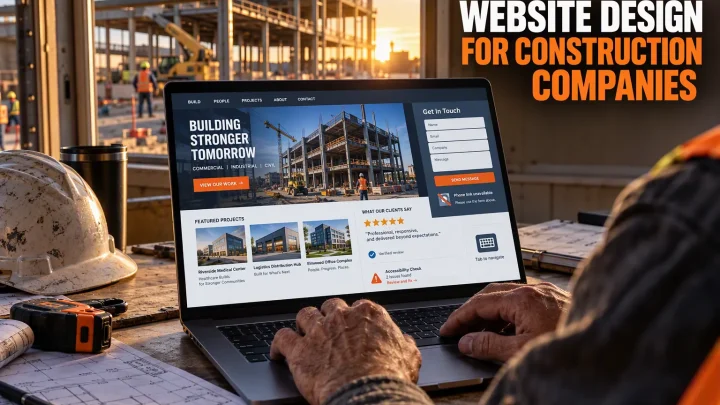
Website Design for Construction Companies
Most advice about contractor websites covers layout, photos and calls to action. Useful, and incomplete. Two federal requirements apply to a construction…

Blog
SEO for Construction Companies
Most contractors approach search as a word problem. Which phrase should the page target, how many times should it appear, what should…

Blog
Why Branding Matters In The Construction Industry
Branding is more than a logo or a catchy slogan; it’s the foundation of a company’s reputation, identity, and connection with its…