
Half of American adults now use an AI chatbot. Pew Research Center surveyed 5,119 U.S. adults from February 17 to 23, 2026, and published the findings on June 17, 2026: 49% use chatbots such as ChatGPT, Gemini or Copilot, up from 33% in 2024, and six in ten say they read the AI summary that sits above their search results. About four in ten use these tools to look things up. For a construction company, that changes where the next call comes from.
What is AI search for a construction company?
AI search is the set of surfaces where a chatbot or a search summary answers a question directly rather than returning a list of links. For a construction company, it means a homeowner, developer or project manager may read a short answer naming three contractors and never open a website at all.
The practical effect is that a contractor is now competing to be named inside someone else’s paragraph. That is a different contest from ranking, and it rewards different work. A company can sit in the results and still be left out of the answer written above them.
What does an AI engine read on a contractor website?
An AI engine reads a contractor website as text. It looks for plain statements of fact: trades performed, counties served, project types, licensing, and the kind of clients served. Photos, sliders and phone numbers carry no meaning to a machine, so a page built on images gives an engine almost nothing to use.
A human visitor fills gaps from context. Standing on a page with a photo of a strip mall reroof, a project manager works out the rest. A machine does not fill gaps. If a homepage never says “commercial roofing contractor serving York and Lancaster counties,” no answer about York County commercial roofers will say it either.
This is a writing problem before it is a technical one. Most contractor sites are missing facts rather than missing words, and the gap between ranking work and answer work is worth understanding before anyone rewrites a page.
Why are construction companies exposed here?
Construction has been slower than most sectors to adopt these tools. U.S. Census Bureau data reported on May 26, 2026 put national business AI use at 19.8% as of May 3, 2026, with fewer than 20% of firms under five employees using AI at all. The buyers awarding work are moving faster than the companies bidding it.
That Census figure cuts two ways. It says most contractors are behind, and it says the field they are competing in is behind with them. A thin market is an opening. In a trade where almost nobody has prepared a site to be read by a machine, the company that does the work stands out quickly and cheaply.
The risk sits on the other side of the same fact. Owners and general contractors who prequalify subs are researching before they call, and the contractors they find are the ones whose sites state their scope in plain language.
What decides whether an AI engine uses a contractor’s site?
Three conditions decide it: access, clarity and depth. A crawler has to reach the site, the page has to state plainly what the company is and where it works, and the content has to answer the follow-up question a buyer would ask next. A page failing any one of the three gets passed over.
Access. If a crawler is blocked at the robots file, the firewall or the CDN, nothing else matters. Confirm the site is reachable and confirm the sitemap has gone to Bing Webmaster Tools as well as Google Search Console, because some engines lean on the Bing index rather than Google’s.
Clarity. State what the company is, where it is based, and what it does, in plain prose, inside the first 150 words of every page. Use the same wording every time. A company described three different ways across one site reads as three different companies, and an engine that cannot resolve which one is correct tends to name a competitor it can resolve.
Depth. A page that answers one question and stops gets skipped. A service page covering how the work is scoped, what a local permit involves, what happens when a survey underestimates the deck, and what an owner should have ready before calling is the page an engine pulls from.
Where do contractors lose the answer?
Contractors lose AI answers to dull, fixable defects: a footer describing the wrong kind of business, a phone link that fails on mobile, service pages that never name a service area, portfolio photos with no written scope, and image alt text bleeding into link text. Each one removes a fact an engine would have used.
The pattern is consistent across contractor sites. The information exists inside the company and never reaches the page. An estimator knows the crew self-performs concrete and subs out the mechanical. The website says “full service.” An owner reading that answer learns nothing, and neither does the machine summarizing it.
Empty testimonial blocks belong on the same list. A heading that promises client feedback with nothing under it is a broken signal on a page where credibility is the whole point.
How long does AI visibility work take for a contractor?
It runs on two clocks. Access and accuracy fixes register quickly once a page is recrawled, since they change facts an engine can read immediately. Third-party coverage and entity records move slowly and cannot be rushed. A contractor should expect the technical corrections to land well before the reputation work does.
Anyone quoting a fixed timeline is guessing. The honest answer is that the sequence matters more than the calendar. Crawler access, indexing and entity accuracy come first because nothing downstream works without them. Writing depth comes next. Trade press and association coverage come last and take the longest.
What should a contractor do first?
Start with access and accuracy before writing anything new. Confirm crawlers are allowed and pages are indexed. Read the footer and about page the way a stranger would, and check that both describe the business the company runs today. Correct the facts, then write.
From there, go through the site the way an engine reads it, line by line, and write down every fact a reader would otherwise have to guess at. Trades, counties, project sizes, self-perform scope, licensing, bonding, the clients served.
Then pick the questions owners ask before they call and answer each one in writing, with the trade and the region named in the answer itself. That is the method. It is slower than a ranking trick and it holds up better, because the facts stay true after the algorithm changes.
Frequently Asked Questions About AI Search for Construction Websites
01Do AI engines send construction companies real work?
They send research, not clicks in the old sense. A project owner reading an AI answer about local contractors may call directly from that answer without visiting a site. Tracking is harder, so contractors should ask new callers how they found the company rather than relying only on analytics.
02Does a construction company need to rank on Google to appear in AI answers?
For one engine, yes. Gemini draws heavily on pages Google has already ranked, so an unindexed page cannot be cited there. Other engines pull from live searches and from training data, where ranking matters less. Indexing is the floor for all of them.
03Should a contractor block AI crawlers to protect their content?
Blocking crawlers makes citation impossible. A contractor who blocks GPTBot, ClaudeBot or Google-Extended removes the company from those surfaces entirely. Publishers with subscription content have reasons to block. A construction company trying to be found by project owners does not share those reasons.
04Does a Google Business Profile matter for AI search?
It matters for any question with a location in it. A claimed profile with correct categories, address and phone feeds the entity record several engines rely on. A contractor working from a home address should confirm eligibility rules before setting one up, since configuration differs for service area businesses.
05How much does AI search optimization cost for a construction company?
Cost depends on how much of the work is technical repair versus new writing. A site with clean indexing and accurate entity facts needs content work only. A site with blocked crawlers, duplicate pages and a wrong business description needs development time first. An audit establishes which situation applies.
06Can a small contractor compete with a large firm in AI answers?
Specificity beats size on these surfaces. A four-truck HVAC company that names its counties, its equipment lines and its commercial scope gives an engine more usable fact than a national firm describing itself in general terms. Narrow, verifiable claims are what get quoted.
MFG Builders: Marketing Built by People Who Worked Construction
MFG Builders is a marketing agency for construction companies, based in York, Pennsylvania. Our team worked in construction before working in marketing, and we have built websites and search strategies for contractors across the country.
Our Services Include:
- AEO for Construction: Access, clarity and depth in that order, so an engine can reach your pages, read what your company is, and find the answer it came for
- Digital Marketing for Construction: The rest of the picture, because an owner reading an AI answer still checks the site, the listing and the project history before calling
Not sure what an AI engine says about your company? Request a quote and we will look at what is actually there.
Works Cited
- Gottfried, Jeffrey, et al. “Americans and AI 2026: Chatbots, Smart Devices and Views on Impact.” Pew Research Center, 17 June 2026, https://www.pewresearch.org/internet/2026/06/17/americans-and-ai-2026-chatbots-smart-devices-and-views-on-impact/.
- Grundy, Adam, Cory Breaux, and Dhanapati Khatiwoda. “Large Firms With at Least 20 Employees Biggest AI Users.” U.S. Census Bureau, 26 May 2026, https://www.census.gov/library/stories/2026/05/ai-use-businesses.html.
Keep reading
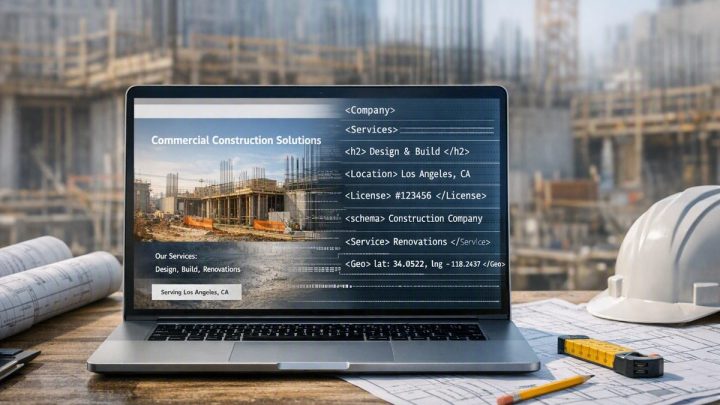
AI-Powered Search Engine
What an AI Engine Reads on a Contractor Website
Open a contractor website, turn the images off, and read what is left. That is close to what a machine gets. On…
Seo
SEO Versus AEO for Construction Companies
There are close to a million construction business locations in this country. The Bureau of Labor Statistics counted 953,703 private construction establishments…
Data Centers Are Splitting Construction Backlog in Two
The headline number looks fine. Backlog looks fine. Underneath it, the market has quietly separated into two economies, and most contractors are…