
There is a lot being sold to contractors under the heading of AI search optimisation, and the most useful starting point is what the largest search company says you do not need. Google’s own guidance states there are no additional requirements to appear in its AI features, that you do not need to create AI text files or new markup, and that there is no special structured data for it. That narrows the subject considerably, and what is left is worth doing.
What is AEO for a construction company?
AEO, or answer engine optimisation, is writing a contractor’s pages so a short passage can be lifted out and used as an answer. The unit is not the page but the forty to sixty word block that names the company, the trade and the region and stands up with no surrounding context.
The difference from ordinary search work is narrower than the marketing suggests. Google published a generative AI guide in May 2026 making the point directly, that optimising for its AI surfaces is still search optimisation rather than a separate discipline. What changes is the shape of the writing, not the foundation beneath it.
What does Google say contractors do not need?
Quite a lot of what gets sold. Google states in its guidance on AI features that there are no additional requirements to appear in AI Overviews or AI Mode, no need to create machine readable files or AI text files, and no special schema.org structured data to add.
Three claims a contractor should push back on, then. That an llms.txt file is needed. That a particular markup type unlocks AI citation. That AEO is a separate service requiring a separate budget from search work. None of those hold against what Google publishes about its own systems.
Two caveats keep this honest. Google speaks for Google, and the other engines publish far less about how they select sources. And structured data still earns its keep for reasons that have nothing to do with AI, which is the next question.
Is schema markup still worth adding to a contractor site?
Yes, for category clarity rather than AI citation. Schema.org publishes a LocalBusiness type with a HomeAndConstructionBusiness subtype built for exactly this trade, alongside Organization and Service types. Marking a contractor up correctly states the business category outright instead of leaving an engine to infer it from prose.
The LocalBusiness vocabulary sits under Organization and carries the properties a contractor actually has: address, telephone, opening hours, area served. Used properly it removes ambiguity. Used carelessly it creates it, because markup that contradicts the visible page is worse than no markup at all.
One change worth knowing: FAQ rich results were dropped by Google in May 2026, so FAQPage markup no longer earns the expanded listing it used to. The markup remains valid and harmless. It simply no longer buys what it once did, and anyone still selling it on that basis is working from old information.
What does AEO actually consist of for a contractor?
Four things: pages that are reachable and indexed, an identical entity description repeated across every page, headings phrased as the questions buyers ask, and answers written to survive being lifted out of the page. None of it is exotic and all of it is work.
Reachability. A page a crawler cannot fetch cannot be quoted by anything. This is where the whole subject starts and where a surprising number of contractor sites fail.
Entity consistency. What the company is, where it is based and what it does, in the same wording in the first 150 words of every page. A company described three ways reads as three companies.
Question headings. “Our Commercial Services” is not something anyone types. “How do general contractors prequalify a mechanical sub?” is.
Standalone answers. Open with the answer, name the trade and the county inside it, and refer to nothing above or below. A passage saying “as mentioned above, our team handles this” is unusable the moment it leaves the page.
What questions should a contractor page answer?
The ones buyers ask before calling and most contractor sites avoid. What the work costs to scope, how long a permit takes locally, what happens to the schedule when conditions differ from the survey, how an owner should prepare before requesting a number, and what the company does and does not self-perform.
Cost and timeline are the two most searched and the two most dodged. They can be answered honestly without stating a figure or a duration, by explaining what drives the number and what changes it. A page that engages with the question beats a page that pretends it was not asked.
The self-perform question is the one commercial buyers care about most and almost nobody addresses. A general contractor building a bid list wants to know which scopes stay in-house. Writing that down plainly is a competitive advantage that costs nothing and is difficult for a competitor to counter.
Why does this matter more for contractors than for most businesses?
Because almost no contractor has done it. The trade that has written county-specific, question-led answers about its scope is competing against a field that has published photo galleries and a phone number. Thin competition is the whole opportunity, and it will not stay thin.
The second reason is that construction buying runs on verification rather than persuasion. An engine assembling an answer is doing something close to what a project manager does: pulling together stated facts about who performs what, where, at what scale. A company that has written those facts down is easy to summarise. A company that has not is easy to leave out.
The work also holds its value. Unlike a ranking trick, accurate statements about scope and service area stay true after the algorithm changes, which is why it belongs with the ongoing upkeep of the site rather than as a one-time project.
Frequently Asked Questions About AEO for Construction Companies
Is AEO different from SEO?
It is a layer on top rather than a replacement. The technical foundation is shared, and Google treats optimising for its AI features as ordinary search work. What differs is the writing: question headings and short self-contained answers rather than long flowing pages.
Does a contractor need an llms.txt file?
Google states you do not need AI text files to appear in its AI features, and no major engine has confirmed using one. The cost of adding it is close to zero, so it is reasonable as an experiment and unreasonable as a paid deliverable.
Should a contractor still add FAQ schema?
Only where it describes questions a visitor can actually see on the page. Google dropped FAQ rich results in May 2026, so the markup no longer produces the expanded listing. It remains valid and does no harm, but it is not the win it was a few years ago.
How does a contractor tell whether AEO is working?
By recall rather than clicks. Write ten buyer questions with no brand names in them, run each several times in fresh sessions across the major engines, and record how often the company is named and which competitors appear instead. Month over month movement is the measure.
Can AEO work if the site is not indexed?
No. Google says a page must be indexed and eligible to appear in Search with a snippet before it can show as a supporting link in its AI features. Indexing is the floor, and writing better answers on an unreachable page changes nothing.
Which contractor pages benefit most from AEO writing?
Trade and service area pages, and cost or timeline questions. Buyers ask those constantly and most contractor sites refuse to engage with them. Answering honestly, without inventing a figure, is both the most useful page and the least contested one.
MFG Builders: Marketing for a Trade That Gets Verified, Not Sold
MFG Builders is a marketing agency for construction companies, based in York, Pennsylvania. Our team worked in construction before working in marketing, and we have built websites and search strategies for contractors across the country.
Our Services Include:
- AEO for Construction: Question-led pages and standalone answers, without charging you for files and markup Google says you do not need
- Digital Marketing for Construction: The foundation underneath it, since nothing gets quoted from a page an engine cannot reach
Been sold an AI package you cannot evaluate? Request a quote and we will look at what is actually there.
Works Cited
Google. “AI Features and Your Website.” Google Search Central, https://developers.google.com/search/docs/appearance/ai-features. Accessed 3 Oct. 2026.
Schema.org. “LocalBusiness.” Schema.org, version 30.0, 19 Mar. 2026, https://schema.org/LocalBusiness.
Related Articles
Keep reading

Blog
Website Maintenance for Construction
Contractor websites rarely break outright. They drift. The service area stops matching where the crews actually travel, the newest project is three…
Blog
Website Design for Construction Companies
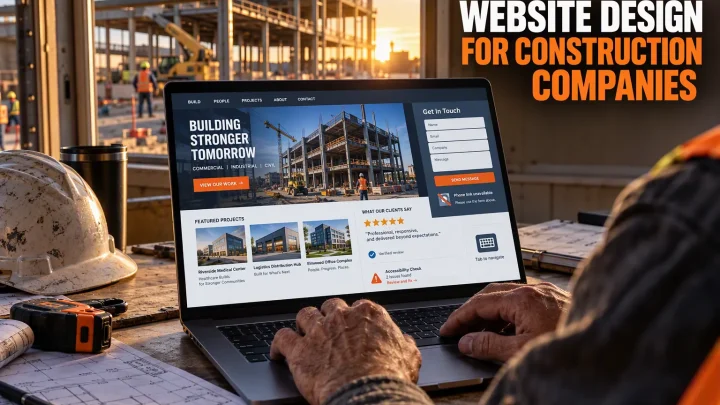
Most advice about contractor websites covers layout, photos and calls to action. Useful, and incomplete. Two federal requirements apply to a construction…

Blog
SEO for Construction Companies
Most contractors approach search as a word problem. Which phrase should the page target, how many times should it appear, what should…